Unknown's avatar

Everything Old is New Again

The U.S. Navy has deployed a converted transport ship, the Ponce, into a floating forward base for helicopters and special operations troops.  The critical changes were the addition of a flight deck and a modular barracks.  Here is The New York Times article.  This reminds me of the escort carriers built during WWII.  They typically used merchant ship hulls and were very cost-effective as convoy protectors.

Marc De Santis

Unknown's avatar

World War Two Warbird Photographs

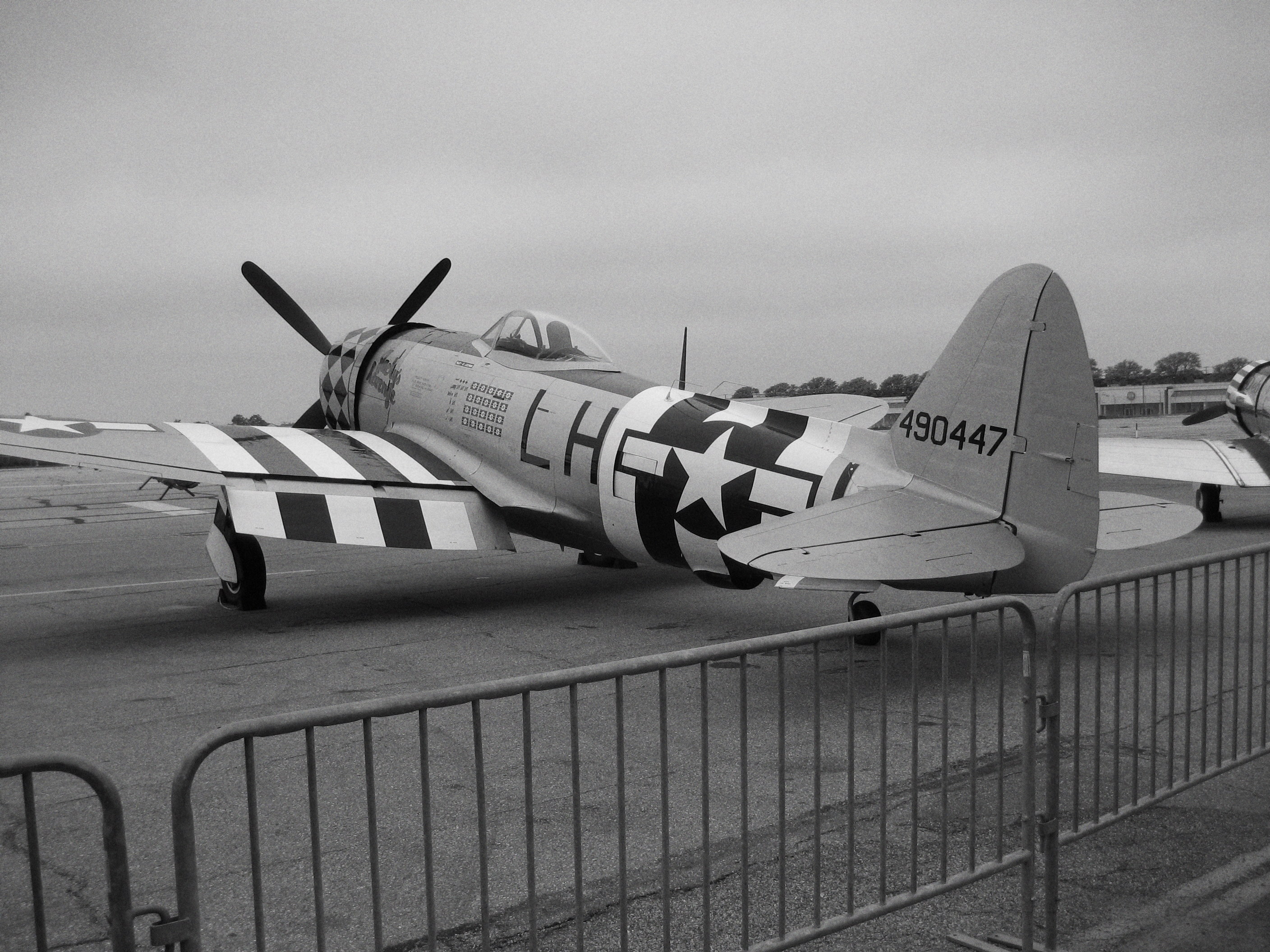
Here are several photos I have of WWII warbirds at the American Airpower Museum in Farmingdale, New York.    So let’s just imagine that we really did discover a trove of old photos that had been mislaid for nearly seven decades.  And ignore the indications of 21st century attire or technology.  It is 1944!

This P51 Mustang is waiting to take off on an escort mission over Germany, June 1944.

This p47 Thunderbolt has just returned from a strafing mission over occupied France, June 1944.

This Navy F4U Corsair waits to take off from the deck of the USS Essex, September 1944.    Please ignore the concrete flight deck.

At this late date in the war, the P40 Warhawk is a second-line fighter, but still soldiers on providing close air support for ground troops.  This machine is stationed in southwestern China, August 1944.

Marc De Santis

Unknown's avatar

Photography Bug Bites

I have been bitten by the photography bug, again.  The butterflies won’t cooperate by staying still, and the birds are remaining in the shade, out of the sun.   So here are some flowers I snapped with my elderly, but still extremely effective, Canon Powershot Elph S600.


Unknown's avatar

Ancient Warfare Dacia Issue

Ancient Warfare, an English-language publication from the Netherlands, is a true gem.  The magazine is full of scholarly articles on ancient military topics, which you will bet I love.  The latest issue’s focus is on the Dacian wars of Emperor Trajan.  These efforts deserve to be better known.  Unfortunately, we lack a good literary source from ancient times that deals specifically with them.  There must have been histories of this kind made, but they have been lost to posterity.

Fortunately, we have one of the best archaeological sources of all – the famed Trajan’s Column – which still stands in Rome.  It depicts the entire Roman army of the first years of the second century A.D. on campaign against the Dacians.  Much of what we know of the appearance of Roman soldiers of the early Empire derives from this monument.

There are top-notch people behind Ancient Warfare.  They also put together fantastic podcasts which you should immediately download from iTunes.  All of them!  I wish that we could have an American version of this journal.  Lucky for us that the magazine is available at Barnes & Noble.

Take a look at the dude below.  Awesome, right?  This is what a legionary – really! – derived from the Adamklissi monument in Romania – looked like.  Very different from what you expected, I’ll bet.  He was likely serving with a legion stationed in the east of the Empire, and fought in Dacia with Trajan.  He has already acquired something of a “Byzantine” appearance.  His spangenhelm helmet was based upon Iranian models.  Great job by the author, Raffaele D’Amato, and the artist, Johnny Shumate!

Marc De Santis

Unknown's avatar

The Desert Fox at MHQ

Erwin Rommel was one of the most interesting figures of WW2.  For a long time there has been talk that he was really only a great divisional commander who was promoted beyond his level of true competency.  Talking about the relative merits of generals is always fun, and incapable of being proven.  Rommel’s achievements in North Africa are undeniable, even though he never had enough men or equipment to do as much as he wanted.  On the other hand, the British siphoned troops from that front to send elsewhere on more than one occasion.  Rommel grabbing the Suez Canal or going even further afield is one of the great “what ifs?” of the war.   Read the fine article by Robert Citino in the Summer issue of MHQ, and take a look at some Rommel and Afrika Korps photos here.  Also, take a look at this article by Professor Citino about the German airborne attack on Crete in 1941.

MGD

Unknown's avatar

Army Looks for New Camouflage

The U.S. Army’s soldiers will be getting new uniforms – eventually.  The current  Universal Camouflage Pattern (UCP), made of a digitally-composed color pattern, has not proven quite as universal as hoped.  It is a fine uniform, ironically, for only a limited environment – the urban.  Otherwise, it doesn’t quite cut it.  It is too light for forest or jungle environments.  It is not brown enough for Afghanistan, and not tan enough for the desert.

Providing soldiers with a proper uniform camouflage is much harder than one might think.  Finding an  acceptable pattern takes a lot of work, and experience in World War II and Vietnam has shown that different places require different patterns,  A universal pattern was a good idea on paper, but not in practice.   Soldiers now deploying to Afghanistan are already getting their new MultiCam duds.  MultiCam looks to me a bit more like modern German camouflage.

The whole story has made me wonder what caused them to change in the first place.   Three-color desert was fine for Iraq, but then the Army went to UCP.  Simply enhancing this pattern with more brown would have been effective for Afghanistan.   UCP was one of those things that must have sounded great, but did not work more effectively than specific solutions tailored for a particular theater.

I have been looking over even older patterns too, and I can’t help but think that the 1981 woodland pattern was great.  Not without flaws, but good for an enormous range of environments.  I also think that the so-called chocolate chip pattern uniform (Desert Storm) was effective.

In any event, this is being called a $5 billion mistake.   Check out this article.

MGD

Unknown's avatar

Super Duper Secret Stealth Drone

This photograph was found on the web recently.  It is purportedly a secret stealth drone similar to the ones already acknowledged to be in the U.S. arsenal.  What strikes me about this photo isn’t so much that we have a machine like this that doesn’t officially exist – it is that we can get a photo of this from space and have it available in full color everywhere.  The Kennedy Administration had nothing remotely like this during the Cuban Missile Crisis back in 1962.   Today, such images are so common that we barely notice the technology.

MGD

Unknown's avatar

2,000 Year Global GDP Chart

Check out this remarkable chart at The Atlantic of the relative share of world GDP over the last 2,000 years.  As you can see, the big story of the last five  centuries is the rise of the share of the western world.

I am not sure how well we can calculate GDP so far back.  The graph assumes a simple metric of one person to one unit of GDP, which may not be entirely accurate.  Who is to say?  At best, this is just a crude measure of economic output.  But the larger point is clear- that a handful of European or European-derived nations (the United States) have had an outsized share of global GDP since the Renaissance and the European discovery of the Americas – from around 1500.

MGD

Unknown's avatar

John Carter Rides Again!

If you have been reading this blog for the last few months (which is as long as it has been going) you will recall that I was very enthusiastic about Disney’s John Carter.   You may also be aware that John Carter cost a sizable portion of Disney’s movie division their jobs.

John Carter has been maligned as a bomb – but is that a fair assessment?  My best movie buddy and I watched the DVD this weekend, and we agreed that the movie was (1) awesome; and (2) flew by.  It is over two hours long but feels like a much shorter film.  This is due in large part to the fast pace.  The action never lets up.  The film’s worldwide take was an impressive $282 million.   That is not pocket change.

Here is the rub:  John Carter cost $250 million to make.  It cost another $100 million to advertise – not that this advertising was apparent in even the slightest degree to me, and I was looking forward to the film.

I can’t believe that John Carter can be called a bomb with a straight face.  A box office bomb makes little money.  John Carter made lots of it, but Disney forgot to control costs.  Any product launch (and that is exactly what a movie is) will fail if expenses spiral out of sight.

I thought that John Carter was much better than Prometheus, which I also enjoyed.  Prometheus has not bombed, but it cost only half of what John Carter did.  That is a big factor.

If you would like to help Disney recoup some its money, the DVD is available at Amazon here.

MGD

Unknown's avatar

Prometheus

I saw Ridley Scott’s latest movie, Prometheus, which is a prequel of sorts to his 1979 masterpiece, Alien.  I thought that Prometheus was a good film, not a great one.  As with many other films these days, you should not tug too hard on any one of the plot threads, or it will all unravel.

Even if you don’t see Prometheus, you should check out Govindini Murty’s fantastic examination in The Atlantic Monthly of the cultural tropes and influences in it.  This might be one of the few times that an article about a film is more interesting than the film itself.

MGD