Unknown's avatar

World War Two Warbird Photographs

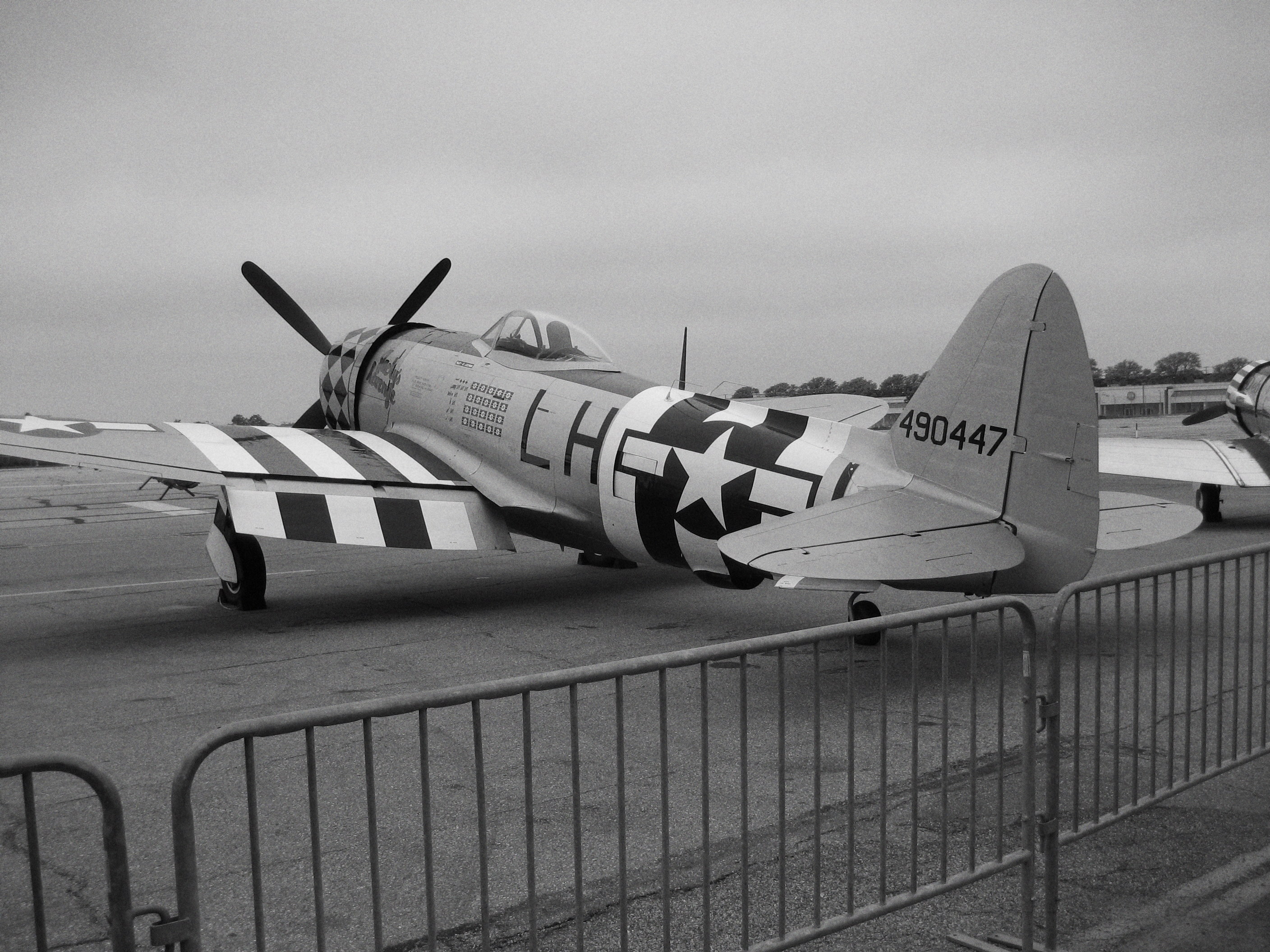
Here are several photos I have of WWII warbirds at the American Airpower Museum in Farmingdale, New York.    So let’s just imagine that we really did discover a trove of old photos that had been mislaid for nearly seven decades.  And ignore the indications of 21st century attire or technology.  It is 1944!

This P51 Mustang is waiting to take off on an escort mission over Germany, June 1944.

This p47 Thunderbolt has just returned from a strafing mission over occupied France, June 1944.

This Navy F4U Corsair waits to take off from the deck of the USS Essex, September 1944.    Please ignore the concrete flight deck.

At this late date in the war, the P40 Warhawk is a second-line fighter, but still soldiers on providing close air support for ground troops.  This machine is stationed in southwestern China, August 1944.

Marc De Santis

Unknown's avatar

Ancient Warfare Dacia Issue

Ancient Warfare, an English-language publication from the Netherlands, is a true gem.  The magazine is full of scholarly articles on ancient military topics, which you will bet I love.  The latest issue’s focus is on the Dacian wars of Emperor Trajan.  These efforts deserve to be better known.  Unfortunately, we lack a good literary source from ancient times that deals specifically with them.  There must have been histories of this kind made, but they have been lost to posterity.

Fortunately, we have one of the best archaeological sources of all – the famed Trajan’s Column – which still stands in Rome.  It depicts the entire Roman army of the first years of the second century A.D. on campaign against the Dacians.  Much of what we know of the appearance of Roman soldiers of the early Empire derives from this monument.

There are top-notch people behind Ancient Warfare.  They also put together fantastic podcasts which you should immediately download from iTunes.  All of them!  I wish that we could have an American version of this journal.  Lucky for us that the magazine is available at Barnes & Noble.

Take a look at the dude below.  Awesome, right?  This is what a legionary – really! – derived from the Adamklissi monument in Romania – looked like.  Very different from what you expected, I’ll bet.  He was likely serving with a legion stationed in the east of the Empire, and fought in Dacia with Trajan.  He has already acquired something of a “Byzantine” appearance.  His spangenhelm helmet was based upon Iranian models.  Great job by the author, Raffaele D’Amato, and the artist, Johnny Shumate!

Marc De Santis

Unknown's avatar

The Desert Fox at MHQ

Erwin Rommel was one of the most interesting figures of WW2.  For a long time there has been talk that he was really only a great divisional commander who was promoted beyond his level of true competency.  Talking about the relative merits of generals is always fun, and incapable of being proven.  Rommel’s achievements in North Africa are undeniable, even though he never had enough men or equipment to do as much as he wanted.  On the other hand, the British siphoned troops from that front to send elsewhere on more than one occasion.  Rommel grabbing the Suez Canal or going even further afield is one of the great “what ifs?” of the war.   Read the fine article by Robert Citino in the Summer issue of MHQ, and take a look at some Rommel and Afrika Korps photos here.  Also, take a look at this article by Professor Citino about the German airborne attack on Crete in 1941.

MGD

Unknown's avatar

Army Looks for New Camouflage

The U.S. Army’s soldiers will be getting new uniforms – eventually.  The current  Universal Camouflage Pattern (UCP), made of a digitally-composed color pattern, has not proven quite as universal as hoped.  It is a fine uniform, ironically, for only a limited environment – the urban.  Otherwise, it doesn’t quite cut it.  It is too light for forest or jungle environments.  It is not brown enough for Afghanistan, and not tan enough for the desert.

Providing soldiers with a proper uniform camouflage is much harder than one might think.  Finding an  acceptable pattern takes a lot of work, and experience in World War II and Vietnam has shown that different places require different patterns,  A universal pattern was a good idea on paper, but not in practice.   Soldiers now deploying to Afghanistan are already getting their new MultiCam duds.  MultiCam looks to me a bit more like modern German camouflage.

The whole story has made me wonder what caused them to change in the first place.   Three-color desert was fine for Iraq, but then the Army went to UCP.  Simply enhancing this pattern with more brown would have been effective for Afghanistan.   UCP was one of those things that must have sounded great, but did not work more effectively than specific solutions tailored for a particular theater.

I have been looking over even older patterns too, and I can’t help but think that the 1981 woodland pattern was great.  Not without flaws, but good for an enormous range of environments.  I also think that the so-called chocolate chip pattern uniform (Desert Storm) was effective.

In any event, this is being called a $5 billion mistake.   Check out this article.

MGD

Unknown's avatar

Super Duper Secret Stealth Drone

This photograph was found on the web recently.  It is purportedly a secret stealth drone similar to the ones already acknowledged to be in the U.S. arsenal.  What strikes me about this photo isn’t so much that we have a machine like this that doesn’t officially exist – it is that we can get a photo of this from space and have it available in full color everywhere.  The Kennedy Administration had nothing remotely like this during the Cuban Missile Crisis back in 1962.   Today, such images are so common that we barely notice the technology.

MGD

Unknown's avatar

America Pivots to the Pacific

Professor James Holmes of the Naval War College is fast becoming one of my favorite web authors. I have blogged about one of his articles before, and this week he has produced another fine piece in Foreign Policy about U.S. strategy in the Pacific, Is America Pivoting Fast Enough to the Pacific? Now that the wars in Iraq and Afghanistan are winding down (hopefully), the Pentagon is moving to bolster American forces in the Pacific.

China will prove to be tough customer in any fight.  The U.S. should be wary of sticking its nose too far into the South China Sea dispute. It is not our territory, and never will be. We don’t want China to steamroll every other Asian nation, but the militaries of those front line countries should be putting forward the bulk of the forces to defend against possible Chinese moves.

Also, Holmes points out that the new LCS – Littoral Combat Ship – about which I have also previously blogged, is not as powerful as a conventional destroyer or similar surface ship. They are not meant to duke it out with the Chinese navy in the South China Sea. Fair enough. But then why are we building them at all if they are so comparatively weak? I understand that they will have uses other than in a full battle, such as fighting pirates or clearing mines, but wouldn’t some smaller, less expensive craft be suitable for such missions? I would prefer a better PT-style boat, armed with guns and a few missiles, not a weak but still expensive frigate that isn’t really a frigate.

During the nineteenth century, the Royal Navy found itself scattered across the globe on various imperial missions. The relative decline of the main fleet in Britain itself caused the German navy chief Alfred von Tirpitz to believe that he could build a fleet that could challenge the Royal Navy in its home waters, his thinking being that Britain’s overseas commitments would render it unable to collect all of its much larger navy back home to resist the German fleet.

He was wrong – very wrong. The British indeed recognized the German threat as paramount, and pulled back most of their forces from overseas stations. They also improved relations with the U.S., which obviated the need for a powerful North American squadron, and concentrated on building big capital ships to maintain their edge over the Germans.

But the damage was already done. The Germans had spooked the British like nothing else had since Napoleon. The anti-German alliance hardened, and Britain was inclined to see every additional ship launched by the Germans as a threat to their existence.  The seeds of the First World War were sown in large part because Germany misjudged Britain’s determination to remain the world’s foremost naval power.

The U.S should not become confused about its priorities. Fighting piracy and other such things are useful, but the role of the navy is to safeguard America, not other nations. To do this, it has to be able to either deter or dissuade other navies from taking hostile actions against it. That means powerful combatants. The LCS does not seem like it is meant to be that kind of a ship.

Not every ship must be powerful. Sometimes a navy needs large numbers of a ship at a low cost. World War Two-era Fletcher class destroyers were not overwhelmingly powerful. But they were true combatants, and did their job well. They were also backed up by large numbers of other ships. Does the building of the LCS take away from funds that might go into fewer but better ships, such as the Arleigh Burke class destroyer? At root, this is a question about how effective the LCS will be in a stand up seafight. I don’t know the answer to that.

This brings up another, fundamental question: Can the Pentagon make anything inexpensively? Does every weapon system have to be equipped with all the bells and whistles? This drives up development time and costs, and makes the finished product all the more expensive. There are some things that will never be cheap, such as a nuclear submarine or an aircraft carrier. If the question is fighting seaborne piracy, however, and it is safe to assume that pirates are not operating destroyers, then a smaller ship is a sufficient solution. I suppose the LCS is meant to be a more affordable ship, but I worry that too many sacrifices were made to keep the price (relatively) low.

MGD


Unknown's avatar

My Old Enemy and the Former Friend of My Possible Future Enemy is Kind of My New Friend

China’s rise, and resulting territorial and maritime ambitions, have caused a number of other Asian nations to look to the United States for backup.  One of these countries is none other than Vietnam.  You all remember Vietnam, don’t you?

Yes, that Vietnam.  Robert D. Kaplan has a lengthy article in the current The Atlantic Monthly.  Apart from highlighting the strategic difficulties that China’s power has caused it – it is scaring other countries into the U.S. “camp”- it contains an illuminating explanation as to why the Vietnamese have gotten past the war, which FYI, they call the “American War.”

Nutshell:  They believe that they won it.

MGD

Unknown's avatar

Battle of Blackwater

Yes, it was a spectacular episode.  Game of Thrones spent an entire hour on the crucial Battle of Blackwater, in which the soldiers of Stannis Baratheon are repulsed by those loyal to Joffrey Lannister.

Tyrion, my favorite character, proves himself to be the real leader of men in King’s Landing.   Read Scott Meslow’s take on the episode in The Atlantic here.

Unknown's avatar

Great Book Alert


The Taste of War: World War II and the Battle for Food 

by Lizzie Collingham

I recently finished The Taste of War by Lizzie Collingham. The subject is the role that food played in causing World War II and how the war was conducted. Germany wanted food security and sought to establish an agrarian empire in Russia. The Nazis planned on starving millions in the process. Japan sought a similar empire in China, and millions of Chinese perished because of the disruptions to agriculture brought on by the Japanese invasion.

Britain could get food from its colonies, but German submarines made this a very tenuous way to feed an island nation. The Russians had the dual misfortune of seeing their food plundered by the Germans and then being underfed by Stalin. America came out pretty well. It alone grew more food during the war than it had before it, and Americans were subject to few of the food restrictions that the peoples of other combatant nations endured.

If you prefer your military history suffused with the acrid smell of gunsmoke, this is not that kind of book. There is only a handful of examples of actual warfare in it. Instead, this is a magisterial, big picture work of history that will change – or at least greatly enhance – your understanding of the Second World War.

The Taste of War is available from Amazon here.

MGD